

Escaping the cobra den with a stretch and a doodle

Last Wednesday, between the carers’ course and the write-together, I had an hour to myself. Just as I was toying between browsing Substack, the memoir I’m reading and YouTube, an email from the financial advisor landed: the hiked mortgage rate we’d been offered on our renewal was going to rise again tomorrow. We had to decide now.
[Now, I’m aware “my mortgage renewal went up” is not the most universally relatable crisis going – I don’t expect any sympathy for the rising costs from having a mortgage to renew. But it’s the specific terror I’ve got to hand this week and I can get terrified by the responsibility of managing the rising costs of living. My nervous system doesn’t do proportion.]
I scrambled to assure him we’d take the option on the table, and to assemble everything he needed to secure it. I knew, logically, that no one was going to give me only a thirty-minute window to find the right documents and get them sent. And yet that’s not how it felt in that moment. I felt totally exposed and incompetent. The adrenaline that coursed through me whilst scrabbling to find everything was like tigers were chasing me. The tension in my body as I typed, searched and double-checked facts and figures became more and more vice-like in its grip. I was still and externally just likely just looked focused, but inside I was at the bottom of a cobra den – squeezed to the shallowest breathing, barely able to acknowledge family stopping to talk to me as they passed.
Here’s the contradiction I sat with afterwards: I created Compassion Journalling – two-pen dialogue is the foundational practice that gives it its name, though the course itself is really a set of embodied tools for meeting people wherever their capacity happens to be. And last Wednesday, two-pen dialogue isn’t what I reached for.
It wasn’t that I abandoned my own method. Two-pen dialogue – writing as myself, then writing back fostering a compassionate voice – is a thinking and feeling practice, and the thinking part wasn’t available. I’d had a full day already – travel, facilitating a community group, prep – and needed to be cognitively fresh for that evening’s write-together. I was too activated to write out the mess, let alone make space for my wise compassionate voice to emerge.
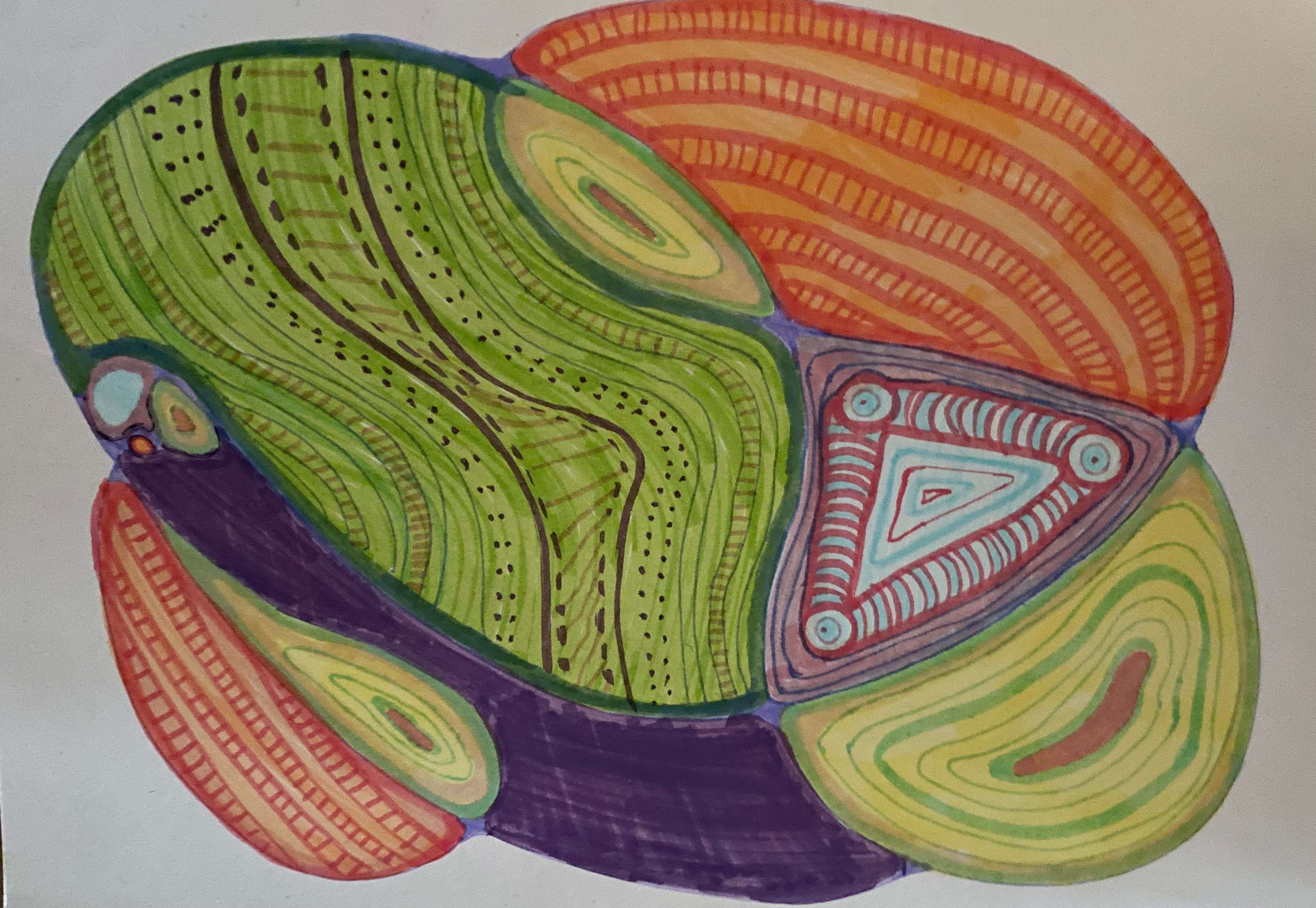
So instead I did what I’d taught the carers group a few hours earlier. One of them had said he sometimes can’t sleep, and asked for something that didn’t need much thinking, for the nights that journalling feels out of reach. I’d shown them a form of doodling that mirrors the shift from threat to soothe state. No words, no dialogue, just colouring pens or pencils moving without needing much executive function to guide it.
The next day, Thursday, a conveyancer emailed asking for information I didn’t have easily to hand. I knew, logically, this was no life-or-death emergency, and no one expected me to produce the documentation and figures like a rabbit out of a hat. But I didn’t trust my own organisational skills to find it in whatever time they’d allow. Not knowing how long it would take, the rest of my to-do list vanished. I became hyperfocused on finding everything asked for. I was back in the cobra pit.
I didn’t keep drilling down this time. After an hour, I peeled myself from the screen and went to yoga as planned. I am not claiming to have nailed self-care – but I now understand enough about my own capacity and neurodivergence to know that if I already needed the regulating effects of yoga, I needed it even more so that day. I trusted I’d find more clarity for the admin I have little confidence in at the best of times once fresh and back in my body. Drilling down while stuck in emergency mode, I just chase my tail.
I’m reminded that developing Compassion Journalling was never about handing people a catch-all tool. It’s about learning to sit with discomfort rather than shy away from it – leaning into the difficult feelings and saying tell me more to the peak anxiety and body alarm bells, rather than censoring, shaming, or stonewalling it with distraction or numbing consumption. Listening for what’s actually at the heart of it offers the ladder out.
When I do that, I can start to assess the real threat level – why I plummet into a metaphorical cobra pit in the first place. More aware of my surroundings, I can see that I’m physically safe, sitting on a comfortable sofa with my laptop. I’m better able to see myself and my situation more objectively, and not reduce myself to a punitive judgement, smothered and rendered helpless with shame.
The truth I am finding: when we kick ourselves extra hard for good measure – to reassure ourselves we’re self-aware, that we’re not letting ourselves off the hook – we in fact are letting ourselves off the hook. Self-flagellation feels like accountability, but it’s a way of avoiding the calmer, harder work of actually mapping out a solution, of assessing what happened and what’s genuinely ours to take responsibility for – past, present and future.
The stories we carry can be fucking bullies. Their strength is that they often carry at least some truth. Their stranglehold is that we silence them before they’re forced to expose the limits of that truth – so we never question them and reframe when necessary.
When we can see ourselves with clarity, we can keep perspective and take the responsibility that’s ours to own. Self-centring is better adulting that’s neither self-condemnation nor catastrophising.
Another resonate post. So useful.
It’s good to remind ourselves to be kind and forgive ourselves for those times when we know the intervention but can’t reach for it in that moment; the times when we revert to our animal responses.
I’m glad you didn’t bin the yoga that day… it might only seem like a small thing, but it’s actually huge to have a time out.
You are so wise!!