
AM I A CHANCER
Expressive art – that prioritises authentic feeling over technical polish – is the heart of my therapeutic writing practice. Which made my own response to this exhibition all the more worth examining.

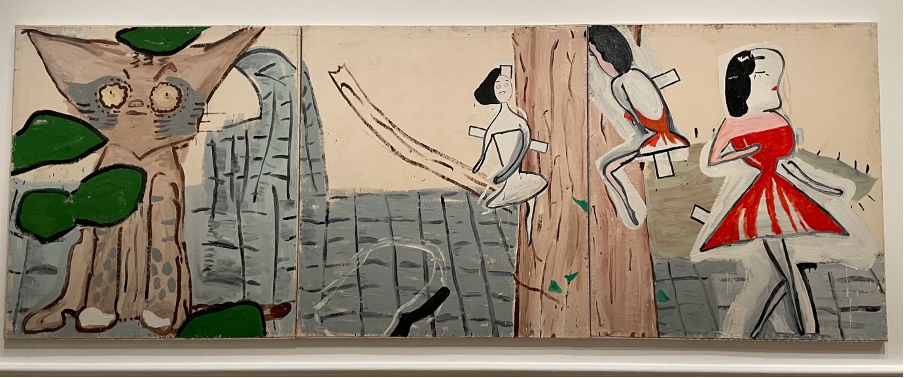
Rose Wylie, Study for Red Twink, 2002 (one of my favourites).
I saw Rose Wylie’s exhibition yesterday with a friend. I chose it to help foster our commitment to joy and playfulness within our own creativity; it left my friend cold, and me flu-like, filled with internal conversation to navigate and unpick.
I’d been wrestling with something before I even arrived – the fact that I encourage my participants to take themselves seriously as writers, whatever their literacy level, and yet resist identifying as a writer myself. It was Annie Ridout, in a short course about being a creative through Substack, who mentioned visiting the exhibition with her daughter. Something in its playfulness appealed to me as playfulness is a quality I want to make more space for in my personal practice.
The Gate-Keeping Dilemma
I was both admiring and a little envious of how playfully and seriously Wylie takes her art, appreciative of the energy in some of them and at the same time mistrusting as to whether some of the pieces actually constitute art. If an imaginative child’s pictures were given the weight of size and the standing of the Royal Academy, would critics necessarily know the difference? Or, like seeing the beauty and meaning in the everyday, does the very act of taking them seriously – of giving time and space to reflective consideration of these art pieces, some modern historical first-hand recollections of recent history – make them culturally important?
We entered into some large naive renderings of planes that felt so flat and child-like, oppressively naive – my first instinct was to feel vaguely insulted that I had paid £22.50 a ticket to witness someone’s childish imaginings. I felt a little embarrassed. I had treated my friend to this outing, designed to inspire us both and excite conversation, and it felt self-indulgent, the visual art equivalent of publishing personal writing without considering the reader.
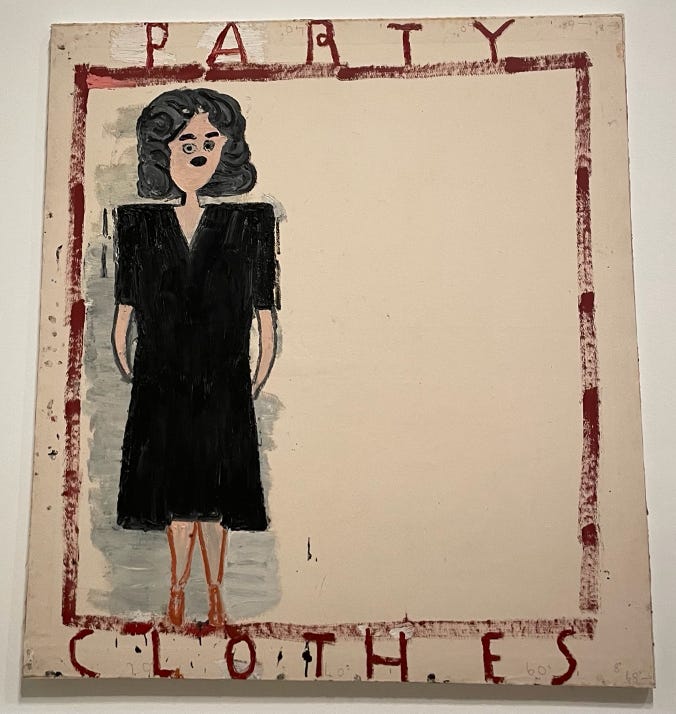
RW Party Clothes (Rose Wylie), 2016
The interpretive blurb described this figure as wearing red lipstick and a 1950s-style conical bra. Looking at her, I couldn’t see either. The lips read black and there is no definition to suggest her breasts in any form, natural or conical. If the official text is getting the image wrong, it makes me question its authority. The internal barometer gauging whether this exhibition exemplified empowering expressive art versus the work of self-indulgent chancers was wavering a little further toward the latter.
To find myself judging myself for both inclinations – gate-keeper and Emperor’s New Clothes victim – makes this exhibition worth reflecting on. I offer these reflections in relation to my own struggles identifying as an artist, specifically a writer, and not as an attempt at serious art criticism – unlike the small huddles of serious-looking artists and critics sharing their insights in low, self-consciously considered tones clustered around the gallery. I don’t think they were part of the exhibit, but they added to its potential for satire.
Picasso is often quoted as saying: “It took me four years to paint like Raphael, but a lifetime to paint like a child”. Although he was problematic as a man, I cannot deny his talent or how his series of bull paintings show his compulsion to find simplicity and child-like energy in form.
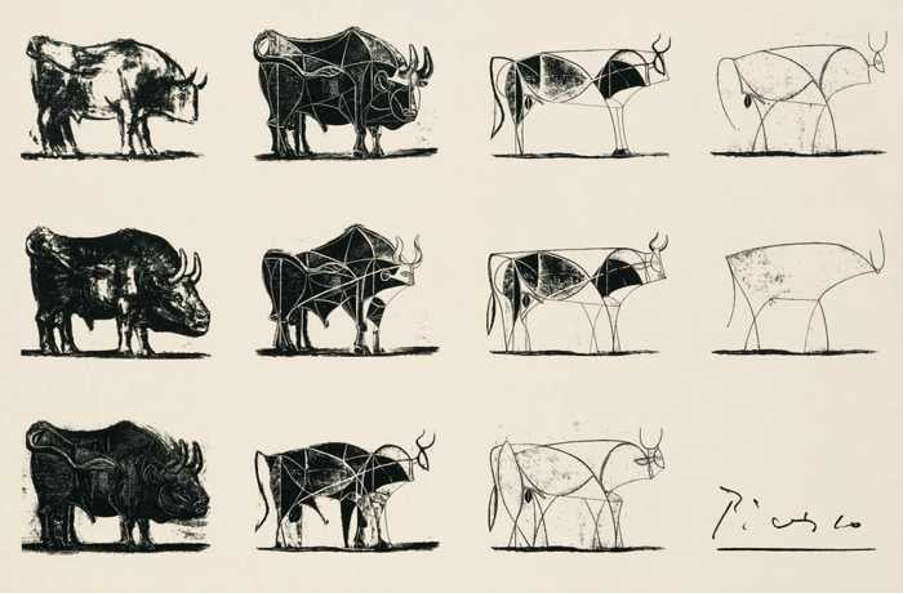
Pablo Picasso, The Bull, 1945
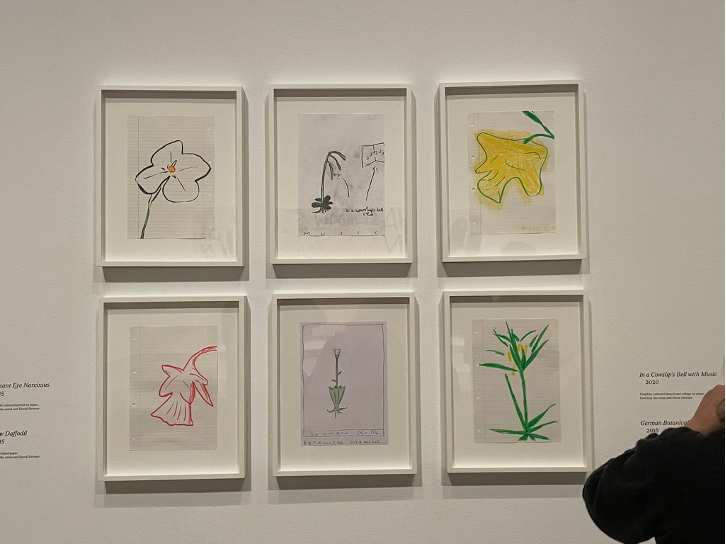
In a Cowslip’s Bell with Music, 2020, King Alfred, 2015, German Botanical Drawing, 2016,
Crown Imperial (From the Garden), 2015.
This botanical series complicated my thinking further. I appreciate the humour in the titles – ‘In a Cowslip’s Bell with Music’ has a Shakespearean reach that the image alone doesn’t quite meet – and yet, as purely visual art, I find myself pondering what to do with it. I can’t help imagining somebody buying it for enormous sums to hang in their house, at the expense of their own and perhaps their children’s art. And yet, I am uneasy, there’s enough vision here to suggest the lack is in fact mine.
What Worked For Me
And yet. I could see and appreciate the energy in others:
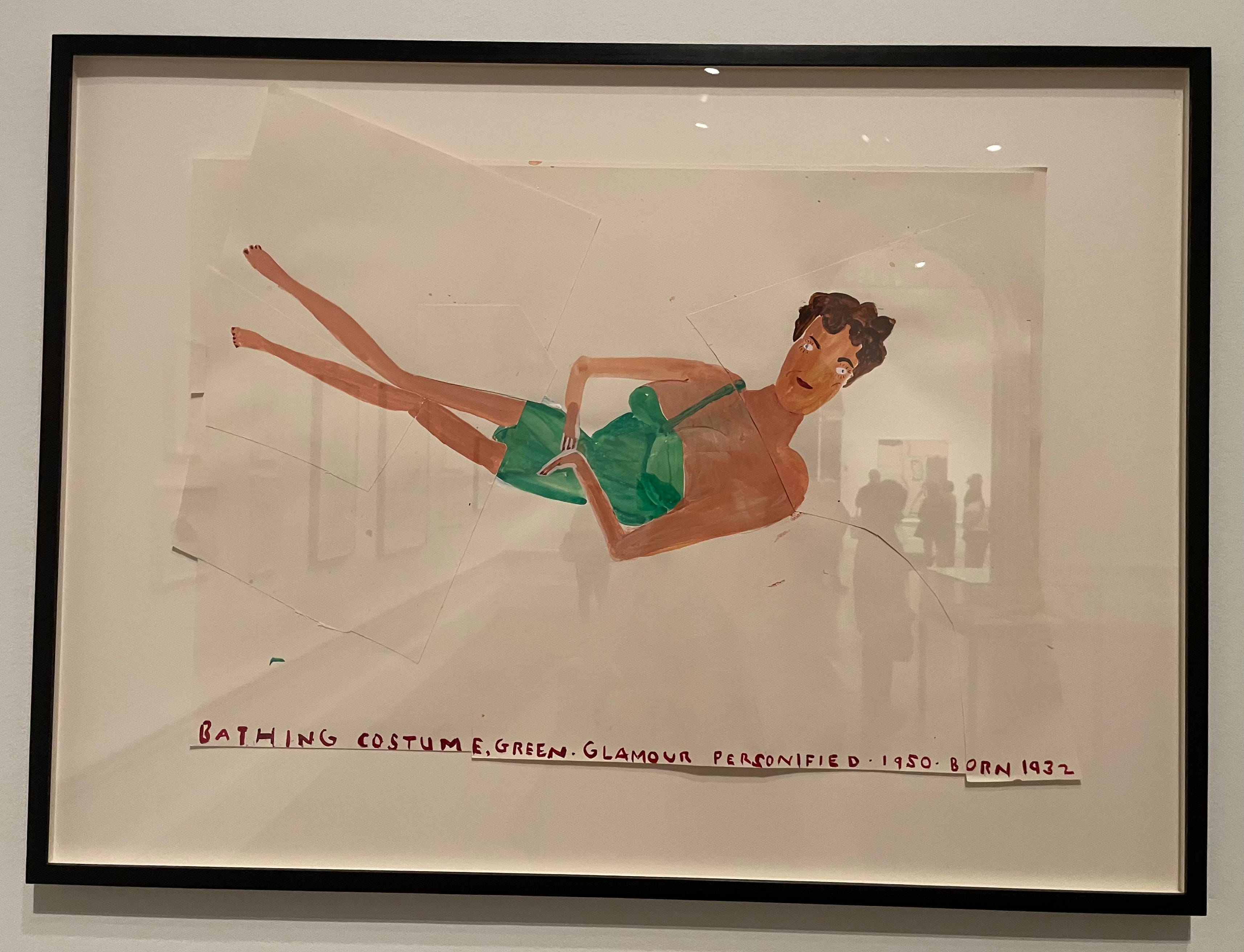
Bathing Costume, Green. Glamour Personified. 1950.
Here the collage technique does something traditional rendering couldn’t – the figure gains embodiment through positioning rather than form. The fragments of paper create a curve that feels present, alive, three-dimensional in a fresh way that the drawing alone might not have achieved.
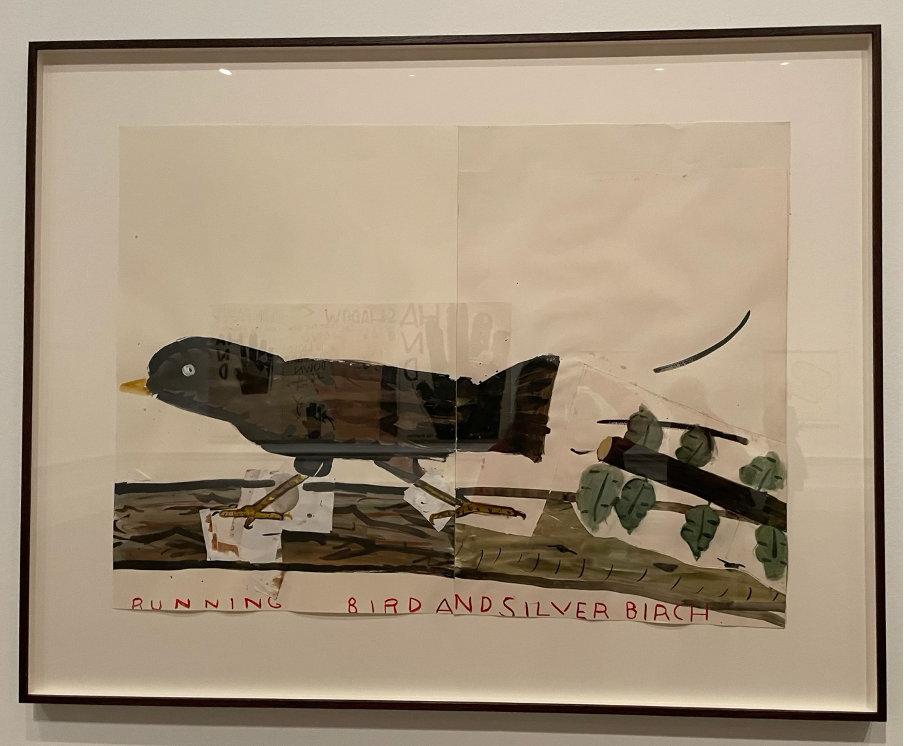
Running bird and silver birch. 2007.
This and the next picture have an undeniable energy for me. I can feel the bird’s sense of agency and purpose in escaping the fold of the page, and the paper doll, so static in nature, gains personality and purpose on the page.
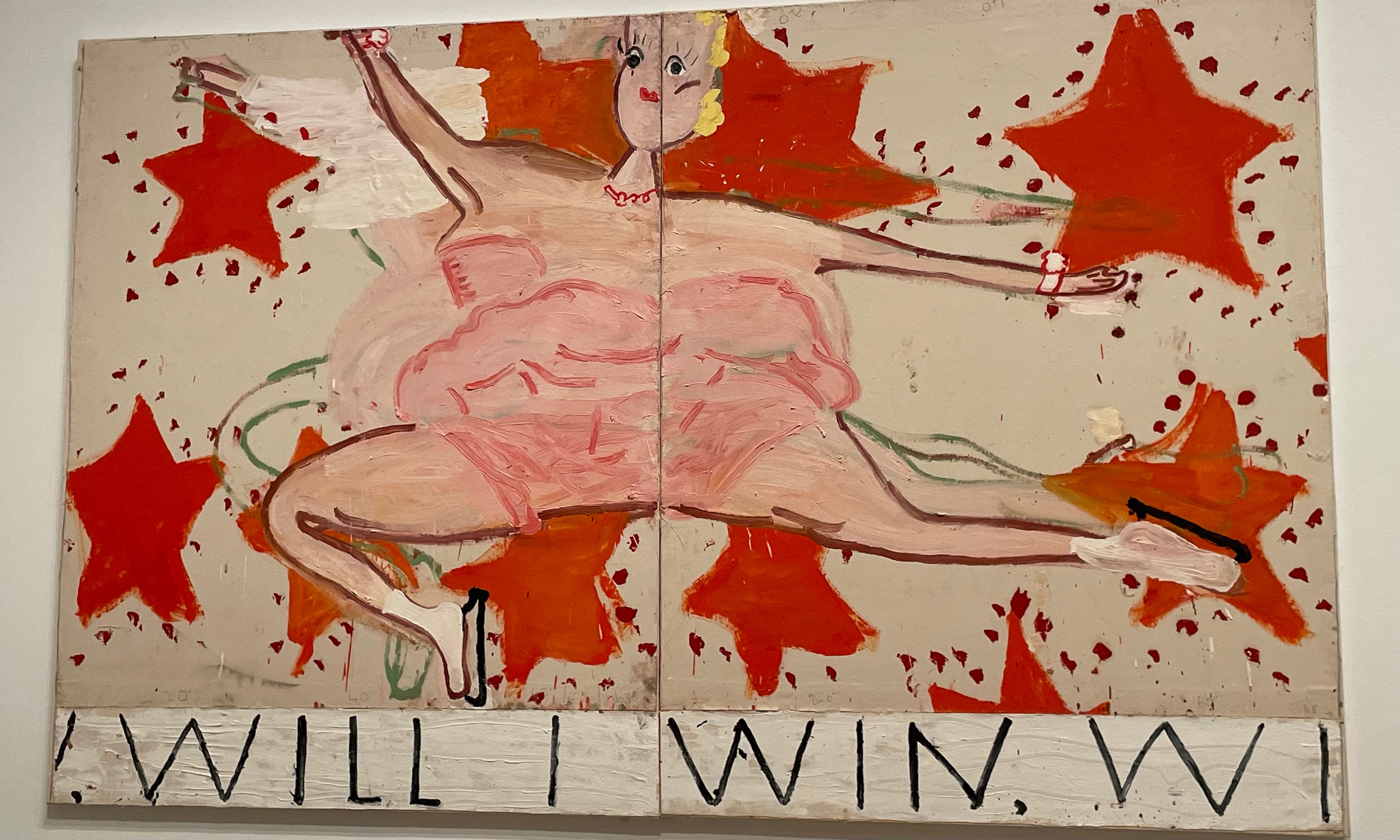
Pink Skater, Will I Win, 2015
This image is playful, feeling both joyful and liberatory, and yet the child-like representation and the infantilised portrayal of the woman brought up conflicting feelings, feeding my fear of exposure through self-delusion.
It feels churlish to note this, like I am raining on her happy parade and yet, it brought up, not judgement of the subject per se, but fear of ridicule in me.
The Need To Contextualise Art
I found myself explaining my choice of exhibition after the first two paintings to my friend – we’re both writing for wellbeing practitioners, so I reached for context to bridge the gap between what we were seeing and what I’d hoped she might see. The first room wasn’t encouraging. She looked politely bemused. I felt the mild social embarrassment of someone who has chosen the restaurant and watched their guest push its offerings around the plate.
Wikipedia – that most democratised of authorities – defines art as work expected to evoke a worthwhile experience through emotional power, conceptual ideas, technical proficiency, or beauty. Standing in front of those first planes, I found myself assessing it, almost with an imaginary tick box. Worthwhile to whom, after all? By whose measure?
For me, art as a process is my primary intention and I see its deeply therapeutic benefits daily but, for it to travel beyond individual experience – to touch the viewer rather than the artist alone – it needs to resonate. These weren’t with either of us. Yet.
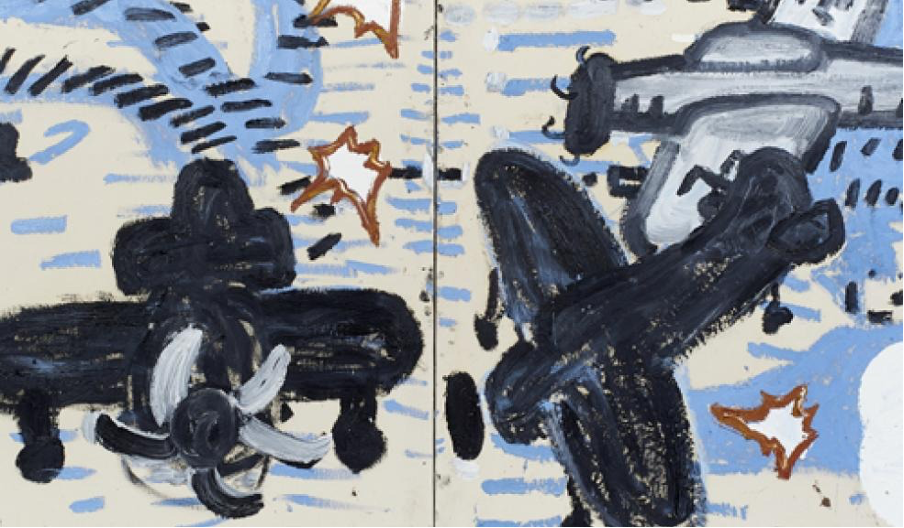
Air Raid, 2015-2017
I didn’t take pictures of any of the aircraft paintings. They didn’t speak to me – until I read the context. And then I felt ashamed at my internal judgements, as if I was robbing her of agency, at the validity of her childhood memory of aerial bombardment being documented and heard. As a historical first-hand account, it contained power and has a right to be witnessed and its terror affirmed. It reminded me of child’s shoes included in war exhibits, and Anne Frank’s house and writing that meant so much to me.
The RA website waxes lyrical:
“Wylie paints freewheeling pictures, often with words loosely scrawled across them, that are gloriously big and crude, and full of a certain dry British humour that sends up any whiff of orthodoxy or pretension.”
Wylie herself is credited with saying “What I absolutely very much like is for them to get into museums where everybody can see them”. I find myself agreeing, and also disagreeing. Working my way through the hallowed exhibition halls with my £22.50 ticket (small concessions are available), I found myself contemplating using some of her work in workshops with independent living and housing trust clients, perhaps alongside artworks from a prisoner exhibition I enjoyed some time ago. Unlike the prisoner exhibition though, this one is only accessible to the privileged which seems a shame.
THE THERAPEUTIC POWER OF ART
Jacky Power – poet and trauma-focused psychotherapist – has been a quiet encouragement here: sharing process poetry not as a route to prizes or publication but for therapeutic benefit, offered openly. James Crews, in conversation with fellow compassion-led poet Julia Fehrenbacher, modelled something similar – his specific reservation about sharing unfinished poems, his years focused on editing anthologies, and his recent return to his own work in Breathing Room, all felt quietly familiar. I relate strongly to this instinct. My work as a therapeutic writing facilitator and co-editor of Lapidus magazine has been genuinely absorbing – but somewhere in the richness of holding space for others, my own creative writing quietly moved to the back of the queue. This exhibition, and the conversation it started, felt like another small nudge to moving it forward again.
What Is Art?
What is art? If it’s to get you talking, it didn’t work for my friend – but it resulted in my conversation with this page in the hope of engaging with you.
A workshop is forming in my mind for anyone who finds themselves judging their own inclinations before they’ve even picked up the pen – exploring who gives us permission to take ourselves seriously as creators, and how the most important permission is the one we give ourselves. Caleb Parkin – poet and contributor to Lapidus magazine – shared these ekphrastic prompts with permission to use and share widely. Over a cuppa after the exhibition, my friend and I picked a picture and answered the following prompts one by one. They create a ten-line growing poem building one word at a time. Why not pick a picture in this article – or one of your own – and have a go:
1. The most important word from the title (1 word)
2. An important texture in the painting (2 words)
3. The most striking colour from the painting (3 words)
4. Some sounds the poem is making (4 words)
5. One thing we love about this painting (5 words)
6. What we’d change about the painting (6 words)
7. A question we’d ask the artist about the painting (7 words)
8. A question we’d ask someone in the painting (8 words)
9. A question we’d ask something in the painting (9 words)
10. Write a new information sign for this painting (10 words)
Whatever this exercise produces for you – a fragment, a single line, something unfinished – please feel free to offer it up in the comments below. You don’t have to have arrived anywhere to share it here.
Thanks for posting this, Kate. So many intriguing ideas in it. The older I get the more I sometimes think that everyone has a touch of the chancer in them....maybe the trick is to out my/our own inner chancer and take the power away from the committee in my head that tends to use anything it can to stop the creative process and belittle the very thought! The first bit of the article made me think of the JM Barrie quote "I am not young enough to know everything". Childlike but not childish. We can but try
An honest and interesting post, Kate. Perhaps it raises more questions than it answers. I suspect any answers will be subjective and personal, but the questions themselves are where the real value of an exhibition lies.